Roofing for Extreme Weather: Building a Shield Against Hurricane, Wildfire, and Hail

Let’s be honest—the weather isn’t what it used to be. It feels more intense, more unpredictable. If you live in a region prone to nature’s fury, your roof isn’t just a top cover; it’s your home’s first and most critical line of defense. Choosing the right roofing for extreme weather isn’t about aesthetics first; it’s about resilience.
Here’s the deal: a standard roof might not cut it anymore. We need to think about specific threats—the brute force of a hurricane, the ember showers of a wildfire, the sudden bombardment of hail. The good news? Modern materials and techniques have evolved to meet these challenges head-on. Let’s dive into what actually works.
The Hurricane Fighter: Battling Wind and Rain
Hurricane resistance boils down to two main enemies: wind uplift and water intrusion. It’s not just the initial gust, but the relentless pressure that tries to peel your roof off like a can lid.
Key Features of a Hurricane-Resistant Roof
- Enhanced Fastening: This is the big one. Forget standard nails. You want ring-shank nails or, even better, hurricane clips and straps that literally tie the roof structure to the walls of your house. It’s the difference between a handshake and a welded connection.
- Impact-Resistant Underlayment: Think of this as a secondary, watertight barrier installed directly on the roof deck. If shingles get torn off, this membrane keeps the rain out. It’s a non-negotiable safety net.
- Sealed Roof Deck: Using a fully sealed deck system (like a peel-and-stick membrane across the whole thing) prevents wind-driven rain from getting in through seams and joints. It creates a monolithic shield.
Best Materials for High-Wind Zones
| Material | Why It Works | Consideration |
| Metal Roofing | Interlocking panels create a continuous surface. Properly fastened, it can withstand winds well over 140 mph. It also sheds water instantly. | Quality of installation is paramount. The interlocking mechanism must be precise. |
| Class 4 Impact-Resistant Asphalt Shingles | Engineered with stronger mat backings and sealants. They’re tested to resist hail, which also means better wind tear resistance. | Look for the UL 2218 Class 4 rating and manufacturer-specific wind warranties (often 130 mph). |
| Concrete or Clay Tile | Heavy, which helps with uplift. When properly mechanically fastened (not just mortar-set), they perform exceptionally well. | Weight requires a reinforced roof structure. Cost can be higher. |
The Wildfire Defender: Stopping Embers at the Top
Wildfires are sneaky. The main threat often isn’t the wall of flame itself—it’s the flying embers, traveling miles ahead, seeking a place to land and ignite. A fire-resistant roof is designed to be non-combustible and to block those embers from finding a foothold.
What Makes a Roof Fire-Resistant?
- Material Combustibility: This is measured by a Class A, B, or C rating. For high-risk areas, Class A is the only real choice. It offers the highest resistance to flame penetration and is effective against severe fire exposure.
- Ember Resistance: The material and design should prevent embers from penetrating into the roof deck or collecting in valleys, gutters, and behind dormers. Smooth surfaces and sealed gaps are crucial.
- Maintenance: Honestly, a clean roof is a safer roof. Removing dry leaves, pine needles, and other debris from valleys and gutters is a simple, vital defense. Debris is just kindling waiting for a spark.
Top Materials for Wildfire-Prone Areas
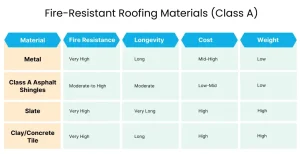
Metal Roofing: Arguably the best performer. It’s non-combustible, embers can’t ignite it, and they tend to slide off smooth metal surfaces. Just ensure it’s installed with fire-resistant underlayment.
Clay & Concrete Tile: Naturally non-combustible and provide excellent ember resistance. Their weight and mass are assets here.
Class A Asphalt Shingles: These are specially made with fiberglass mat bases and mineral granules. They’re a good, cost-effective option, but pay close attention to the underlayment—using a non-combustible type adds a critical layer of protection.
The Hail Survivor: Withstanding the Ice Hammers
Hail is pure impact energy. It turns your roof into a drum, and a cheap drumskin will puncture. Hail-resistant roofing is all about absorbing and dispersing that energy without cracking, bruising, or granule loss that leads to premature aging.
Understanding the Hail Impact Rating
The standard is the UL 2218 test. They literally drop a steel ball from varying heights onto the material. Ratings go from Class 1 (weakest) to Class 4 (toughest). In hail alley or any severe storm area, insist on Class 4. It means the material survived a 2-inch steel ball drop without cracking. That’s serious.
Materials That Can Take a Pounding
- Impact-Resistant (IR) Asphalt Shingles (Class 4): These use a modified asphalt—often with rubberized polymers like SBS—that stays flexible in cold impact. The granules are also more tightly embedded. They can look identical to standard shingles but perform worlds better.
- Metal Roofing (Standing Seam): Thick-gauge standing seam metal (think 24 or 22 gauge) dents but rarely punctures. The vertical seams are raised, so hail strikes the flat field, which can handle it. The denting is often cosmetic, not functional.
- Synthetic Slate/Rubber: Products made from engineered polymers or recycled rubber are incredibly tough and impact-absorbent. They mimic high-end slate or wood but laugh off hail strikes.
Putting It All Together: The Overlap and The Installation Truth
You might have noticed a pattern—metal roofing appears in all three categories. It’s a fantastic all-arounder for extreme weather resistance. But it’s not the only option, and cost or style might lead you elsewhere.
Here’s the crucial part, the thing that honestly matters as much as the material itself: installation. The best, most expensive hurricane-rated shingle will fail if it’s nailed wrong. The finest Class A tile is useless if embers can slip through gaps at the eaves.
Find a contractor who doesn’t just sell a product but understands the system required for your specific threat. Ask them about their fastening patterns, their underlayment choices, their sealing methods. A roofer who geek out on these details is worth their weight in gold.
A Final, Grounded Thought
Investing in a roof for extreme weather is an act of foresight. It’s acknowledging that our environment has shifted and that our homes need to adapt alongside us. It’s not just about surviving the next storm or fire season; it’s about peace of mind, about creating a shelter that lets you weather the literal storms with one less thing to fear.
The right roof doesn’t shout—it just stands its ground, quietly and reliably, season after season. And in the end, that resilience becomes part of your home’s story.